
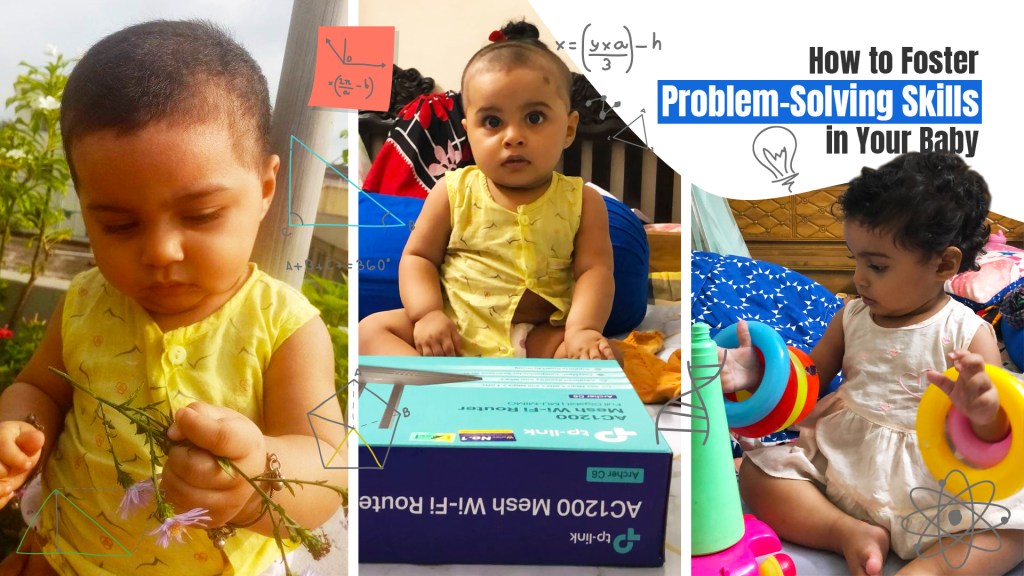
As a parent, you play a pivotal role in shaping your child’s cognitive development, especially their ability to solve problems. Problem-solving is not just about puzzles and tasks; it’s about how children learn to navigate challenges, understand cause and effect, and interact with their world. Problem-solving begins in infancy and grows through nurturing relationships, play, and guided exploration.
Here’s how you can intentionally foster these skills from the very start, backed by developmental science and real-world strategies.
Table of Contents
- Why Problem-Solving Starts Early
- Practical Ways to Nurture Problem-Solving
- What the Research Says
- When to Seek Guidance
- Final Thoughts
- Support us ❤️
- References
Why Problem-Solving Starts Early
From birth, babies are active learners. They quickly discover that their actions, such as crying, cooing, or reaching, elicit responses from caregivers. This is the earliest form of cause-and-effect learning, a cornerstone of problem-solving (Shonkoff & Phillips, 2000). According to the Illinois Early Learning Guidelines (Capito & Yarbrough, 2012), even in the first nine months, babies begin to use signals to get their needs met and repeat actions to see what happens, which is a foundational behavior in problem-solving.
By 7–18 months, toddlers start experimenting more intentionally: they may drop a toy repeatedly to hear the sound or see if you’ll pick it up. This trial-and-error approach is a critical step in cognitive growth.
Practical Ways to Nurture Problem-Solving
1. Respond Warmly and Consistently
Responding in a timely and caring manner to a baby’s cries or gestures fosters secure attachment, in which infants come to expect caregiver availability and support (Ainsworth et al., 2015). Secure attachment is associated with stronger executive function, self-regulation, and more effective problem-solving behaviors later in childhood, as children learn that their actions elicit predictable and supportive responses from caregivers (Bernier et al., 2012).
Example: If your baby reaches for a toy just out of reach, gently hand it to them while describing what they’re doing: “You’re reaching for the red ball!”
2. Create a Safe “Yes” Environment
Child-proof your space so your baby can explore freely without constant “no’s.” Exploration is essential for problem-solving. Provide age-appropriate toys that encourage manipulation, such as stacking rings, soft blocks, shape sorters, and cause-and-effect toys (like push-and-pop toys).
My Daughter’s Journey with Her Swing Ring Stacking Toy
Every toy comes with an instruction manual, but children write their own. This is the story of a Swing Ring Stacking Toy that was never stacked. Instead, it became a sensory teether, a motor skill challenge, and finally, a toddler’s prized jewelry collection—celebrating the unexpected paths of development and imagination.
We introduced this stacking toy to my daughter in July 2024, when she was about 9 months old (born October 2023). At that stage, she was deeply engaged in exploring the world through her mouth and was developing her foundational gross and fine motor skills.
Initially, she was unsure of the toy’s purpose. The concept of stacking was beyond her, but she was fascinated by the rings as objects. She would practice holding them and, true to her phase, would inevitably bring the narrow tip of the cone or the rings to her mouth to chew on. This was her primary way of interacting with it.
Now, at about 16 months old (around February 2025), her interaction has evolved significantly. She can firmly grasp both the central cone and all the colorful rings. However, her interest has taken a creative detour. Rather than stacking the rings by size on the cone, she has invented her own game: she wears them on her wrists like bangles. While she doesn’t yet engage with the toy’s intended purpose of sorting by size or building the tower, she is clearly mastering object manipulation and has found a way to make it uniquely her own.
3. Let Them Struggle (A Little)
It’s tempting to step in immediately when your child seems frustrated, but allowing them to persist through mild challenges builds resilience and independent thinking. The Guidelines note that toddlers learn through trial and error, like trying to fit a shape into a sorter.
Tip: Wait a moment before helping. You might say, “You’re trying hard. Can you turn it the other way?”
Can She Lift It? My Daughter’s First Big Box Challenge!
Over the past seven months, my daughter has mastered the fine motor skill of grasping and holding small objects. Having reached this milestone, we introduced a new, more challenging activity: a large, empty router box. While she can easily lift smaller items, the box’s size presented a novel challenge. Under close supervision, we watched her try to grapple with its size. Though she expertly pushes it around, the act of grasping and lifting it remains just out of reach—a perfect and safe challenge for her current skills.
4. Use Rich Language
Narrate what your child is doing and label problems and solutions. This helps build cognitive connections between action and outcome. Research shows that language-rich interactions support executive function and problem-solving skills (Hirsh-Pasek et al., 2015).
Example: “You pushed the car under the couch. How can we get it out? Should we try reaching with this stick?”
Eager to support their speech and communication skills?
Explore ways to encourage early communication. Read the following blogs:
5. Encourage Pretend Play
Around 18–24 months, symbolic play emerges. Pretend play, like using a banana as a phone, helps children think flexibly and experiment with roles and solutions. Join in their play and follow their lead to extend their thinking.
6. Offer Choices
Simple choices (“Do you want the blue cup or the red cup?”) give toddlers a sense of control and practice in decision-making, a practical form of problem-solving.
7. Model Problem-Solving
Verbalize your own thinking process. “Hmm, this lid won’t open. Maybe if I twist it harder or ask for help…” Children learn by watching you.
What the Research Says
- Secure attachment is linked to better executive function and problem-solving abilities (Bernier et al., 2012; Mukti & Hendrawan, 2018)
- Play-based learning in infancy enhances cognitive flexibility and innovation (Muentener et al., 2018)
- Responsive parenting predicts stronger self-regulation and problem-solving skills later in childhood (Blume et al., 2025; Rungsattatharm et al., 2025)
When to Seek Guidance
Most children develop problem-solving skills at their own pace, but if your child shows no interest in cause-and-effect toys by 12 months, does not try to communicate needs through gestures or sounds, or seems consistently frustrated without attempting solutions by age 2, consider discussing it with a pediatrician or early childhood specialist.
Final Thoughts
Fostering problem-solving isn’t about teaching—it’s about providing opportunities, responding thoughtfully, and celebrating small victories. Your baby is a natural scientist, exploring and experimenting every day. By being their supportive guide, you’re helping build a foundation for lifelong learning and resilience.
Support us ❤️
Raising a baby is a journey filled with love, learning, and everyday discoveries. If you find value in what we share on Raising a Baby and would like to support our work, you can contribute via PayPal. Every bit of support helps us continue this journey—thank you for being part of our story.
References
Ainsworth, M. D. S., Blehar, M. C., Waters, E., & Wall, S. N. (2015). Patterns of attachment: A psychological study of the strange situation. Psychology Press.
Bernier, A., Carlson, S. M., Deschênes, M., & Matte-Gagné, C. (2012). Social factors in the development of early executive functioning: A closer look at the caregiving environment. Developmental Science, 15(1), 12–24. https://doi.org/10.1111/j.1467-7687.2011.01093.x
Blume, J., Garcia, G. M., Garcia, M., & Mastergeorge, A. M. (2025). Associations between parenting styles and child self-regulation skills: A series of meta-analyses. Journal of Family Psychology, 39(7), 885–898. https://doi.org/10.1037/fam0001379
Capito, J. M., & Yarbrough, K. (2012). Illinois Early Learning Guidelines: For children birth to age three (IELG). https://illinoisearlylearning.org/resources/ielg/
Hirsh-Pasek, K., Zosh, J. M., Golinkoff, R. M., Gray, J. H., Robb, M. B., & Kaufman, J. (2015). Putting education in “educational” apps: Lessons from the science of learning. Psychological Science in the Public Interest, 16(1), 3–34.
Muentener, P., Herrig, E., & Schulz, L. (2018). The efficiency of infants’ exploratory play is related to longer-term cognitive development. Frontiers in Psychology, 9, Article 635. https://doi.org/10.3389/fpsyg.2018.00635
Mukti, Y., & Hendrawan, D. (2018). Early education matter: The power of child-parent attachment quality in predicting child’s executive function. Jurnal Ilmu Keluarga Dan Konsumen, 11(1), 74–83. https://doi.org/10.24156/jikk.2018.11.1.74
Rungsattatharm, L., Tasingha, P., Trairatvorakul, P., & Chonchaiya, W. (2025). Longitudinal associations between executive function and positive parenting during early childhood and resilience, self-regulation, and behavioral problems in school-age children. Child and Adolescent Psychiatry and Mental Health, 19(1), Article 19. https://doi.org/10.1186/s13034-025-00875-8
Shonkoff, J. P., & Phillips, D. A. (Eds.). (2000). From neurons to neighborhoods: The science of early childhood development. National Academies Press. https://doi.org/10.17226/9824


