
Parents often hear advice like:
Give finger foods early – chewing strengthens the mouth and helps babies talk.
It sounds logical. After all, eating and speaking use the same mouth, tongue, and jaw. But what does science actually say?
The answer is more interesting, and more reassuring, than a simple yes or no.
Here’s the evidence-based truth: Chewing and feeding experiences contribute to the foundation of oral development, but they are not the main drivers of speech development. What really matters most is social interaction and language exposure – talking, responding, reading, and playing with your baby.
Table of Contents
- Scientific Findings
- 🗣️ 1. Speech development is not just about the mouth
- 🍽️ 2. Feeding and oral motor skills: Foundation, not shortcut
- 🧠 3. What research really says about chewing and speech
- 🥘 4. Why introducing food textures still matters
- 👶 5. Infant-led feeding and language: An interesting connection
- 🗣️ 6. What does help your baby talk better: Evidence-backed tips
- 👀 Observe milestones
- 🚫 What parents should not worry about
- 🩺 When to seek professional advice
- 📝 The take-home message for parents
- References
In this article, you’ll explore evidence-backed strategies to support your baby’s speech development, age-appropriate milestones to look for, common concerns that don’t justify worry, and clear guidance on when professional support may be helpful.
Scientific Findings
Before we dive in, let’s unpack the science behind early communication and clear up some common myths and misconceptions.
🗣️ 1. Speech development is not just about the mouth
Language development is a brain 🧠 skill built through interaction. Language skills grow through:
- listening,
- social interaction,
- imitation,
- and repeated back-and-forth communication.
Babies learn language through serve-and-return interaction, the back-and-forth exchange between your baby’s sounds and your responses. This type of engagement helps build the neural pathways for language and communication.
Real Research Findings
The concept of serve-and-return has been described by developmental science researchers as a foundational brain-building process, where responsive social exchanges help strengthen neural circuits essential for communication, language, and cognitive development. For example: Responsive exchanges between babies and caregivers help form and stabilize neural connections that support later language and social skills.
A longitudinal study found that when parents respond promptly and meaningfully to infants’ vocalizations, gestures, or looks at 9 months, this back-and-forth interaction was associated with higher language skills later at 18 and 24 months (Chen, Cabrera, & Reich, 2023)↗️.
Even advanced computational models show that infant vocabulary development follows structured learning patterns over time, shaped by relationships between words (semantic, perceptual, and sensorimotor relationship that help predict which words are learned next) rather than simple maturation ( Physical growth of the vocal tract and articulatory muscles, General neurological development due to age alone, Time-based increases in ability without modeling what is learned or how) alone (Roxburgh, Grasso, & Payne, 2024)↗️.
However, at the same time, babies must also develop oral motor control, how their lips, tongue, jaw, and cheeks move together. Feeding experiences play an important role here.
Researchers have been asking for decades (Burr, Harding, Wren, & Deave, 2021)↗️:
Is feeding a pre-speech skill?
The best answer from current evidence is: Feeding supports the foundation, but it does not replace language interaction. Hence, the strongest, most consistent predictor of word learning is responsive and rich communication, not chewing practice.
🍽️ 2. Feeding and oral motor skills: Foundation, not shortcut
From birth to 12 months, babies move through predictable stages of oral development:
- Early months: sucking and swallowing breast milk or formula
- Around 6 months: transition to mashed or puréed foods, early tongue lateralization
- Later infancy (by ~8–10 months): chewing, biting, managing soft pieces, finger foods
This progression helps babies learn coordination (movements in the jaw, tongue, and lips), strength, and sensory tolerance in the mouth ((Delaney & Arvedson, 2008; Kuswanti et al., 2024)↗️.
Importantly, this development is about function, not just muscle strength. Speech requires precise, fast, coordinated movements—not simply “strong” muscles.
There is also evidence that delayed introduction of food pieces beyond ~10 months is associated with slightly lower parent-reported neurodevelopmental outcomes later (up to 3.5 years old), though causation (cause-and-effect relationship) isn’t clear (Somaraki et al., 2024)↗️.
In a nutshell, chewing itself is not a “speech training” task.
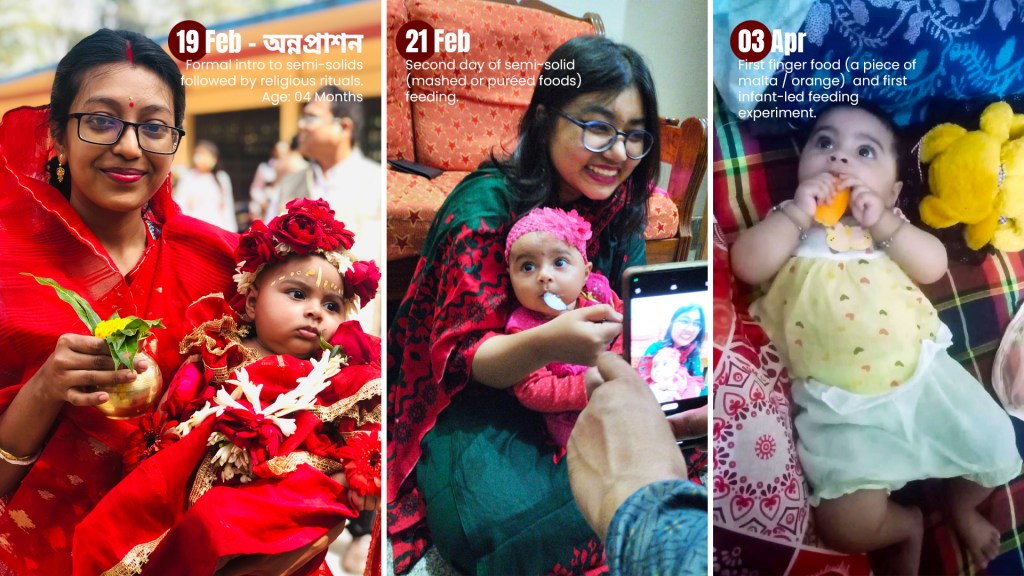
Story of our daughter: Annaprashan







At the age of four months, on an auspicious day, we formally introduced semi-solid food to our beloved daughter through the traditional Hindu ceremony of Annaprashan↗️. On this occasion, we visited a temple and performed the prescribed religious rituals according to Hindu scriptures. Following the rituals, she was offered a very small amount—just a few grains—of mashed sweet rice (payesh / mishti anna), prepared with milk and sugar.
This ceremony marked the formal beginning of introducing food other than breast milk. Until this day, she had been exclusively breast-fed.
🧠 3. What research really says about chewing and speech
💡 Chewing and speech can be related — but not in a direct cause-and-effect way.
Studies in children with neurological conditions (e.g., cerebral palsy) show that chewing skills and speech intelligibility are associated. This suggests that when oral motor control is impaired, feeding and speech difficulties may co-exist (better normal chewing scores correlated with higher speech intelligibility, and more abnormal chewing was associated with lower intelligibility). However, this context involves broader motor coordination issues, not a simple “chewing makes speech better” mechanism (Chang, Sim & Kwon, 2012)↗️.
In typically developing children, the relationship is indirect, complex, and inconclusive (due to limited and inconsistent evidence). Early researchers questioned whether eating and speaking develop together, but could not prove a simple cause-and-effect link (Burr et al., 2021)↗️.
In other words:
✔️ Feeding and oral experiences contribute to oral coordination
❌ They do not replace the foundational role of language exposure through interaction.
Chewing and speech share some underlying motor foundations. But chewing alone does not “teach” a baby to talk.
🥘 4. Why introducing food textures still matters
Even though chewing doesn’t magically produce words, introducing age-appropriate textures is still important.
A recent birth-cohort study found that delayed introduction of food pieces was associated with differences in neurodevelopmental outcomes, including communication-related domains (Somaraki et al., 2024)↗️.
Real Research Findings
A large nationwide birth cohort study from the French ELFE cohort specifically investigated the timing of introduction to food pieces (texture) in infancy and its association with neurodevelopmental outcomes up to age 3.5 years. It found that:
- Late introduction to food pieces (after 10 months, compared to earlier introduction before 8 months) was associated with lower standardized neurodevelopmental scores at ages 1, 2, and 3.5 years.
- These included a lower language acquisition score at 2 years, which pertains to communication-related development.
- Infants with late introduction also had a higher risk of being classified at risk for developmental delay at 3.5 years (Somaraki et al., 2024)↗️.
Other research highlights that feeding experiences influence:
- Oral sensory awareness and oral motor coordination: Research on oral sensory processing shows that a child’s responses to oral sensory input (taste, texture) are related to feeding behaviors and oral motor skills. For example, higher oral sensory sensitivity correlates with fussiness and acceptance of different foods, indicating that sensory experiences are integral to feeding skill development (Delahunt et al., 2024)↗️.
- Mouth movement coordination & confidence: Studies on oral-motor interventions show that structured sensory-motor stimulation and therapy can improve oral coordination (jaw, tongue, lip movements) and overall feeding performance (Aswathy et al., 2024)↗️.
My daughter’s early journey into discovering textures and self-feeding
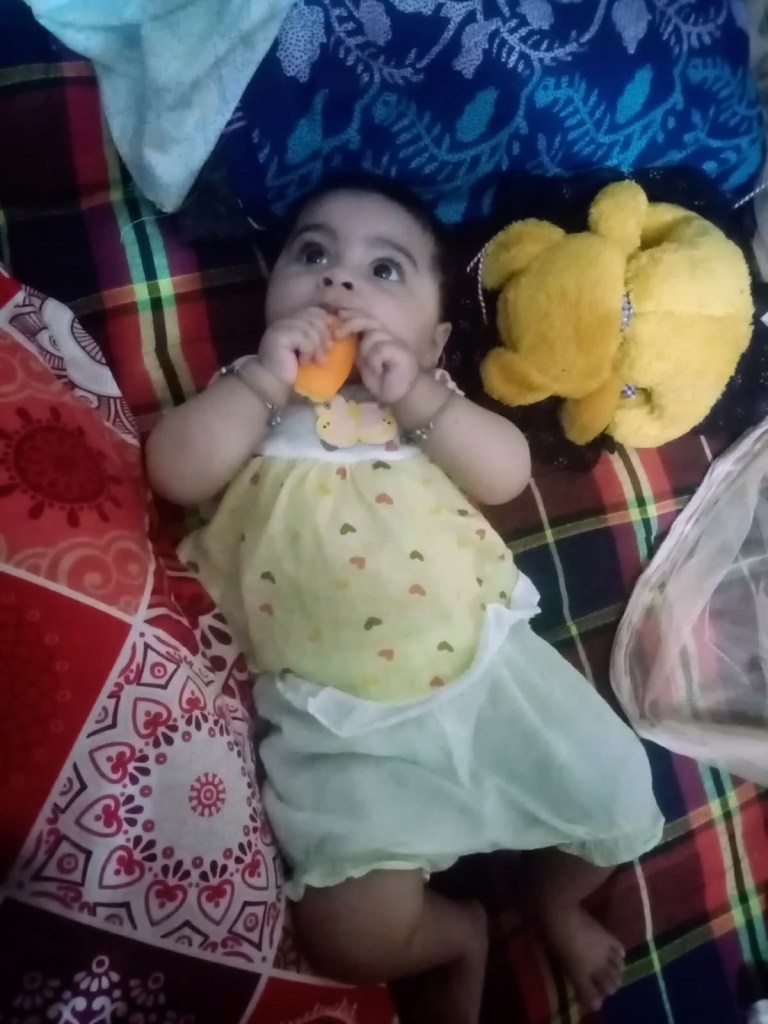
This moment marks one of her earliest experiences in discovering different food textures and self-feeding.
👶 5. Infant-led feeding and language: An interesting connection
One especially interesting finding comes from research on infant-led complementary feeding. Infant-led feeding is defined as when babies are allowed to:
- self-feed,
- explore food, and
- control pacing.
Infant-led feeding approaches (where babies self-feed finger foods and participate in family meals) have been linked to better language comprehension and production later on because they shape mealtime dynamics where more communication naturally occurs (Webber et al., 2021)↗️.
An observational study also found that when infants self-feed during mealtimes, caregivers naturally talk more to them, and babies respond with more vocal sounds and babbling. This back-and-forth interaction creates a richer language environment, giving babies more opportunities to hear words, practice sounds, and learn how conversations work. Observational research shows that these simple moments—letting babies feed themselves and engaging with them while they do—can support early language development, helping babies build both understanding and speaking skills over time (Farrow et al., 2025)↗️.
Why?
Not because of chewing alone—but because these meals:
- involved more interaction,
- more turn-taking,
- more shared attention,
- and more responsive communication.
So the bottom line is, it’s not the chewing itself — it’s the interaction, social context, and communication around feeding that matters.
🗣️ 6. What does help your baby talk better: Evidence-backed tips
Based on the combined evidence, the most powerful supports for speech development are:
1. 🧠 Responsive interaction (every single day)
Talk with your baby often. Describe what you’re doing, what your baby is focusing on, and what’s happening around you.
2. 🔄 Serve-and-return interaction
When your baby:
- babbles → you respond
- points → you name it
- vocalizes → Imitate their sounds, add one word, wait for their response.
This “serve-and-return” interaction builds the brain networks for language and early conversational skills.
3. 📝 Talking during routines
Feeding time is perfect for language:
- “You’re eating a banana.”
- “Crunch! You bit it.”
- “More? All done?”
Food becomes a reason to communicate, not just something to chew.
4.📚 Reading, singing, and gestures
Books, songs, and simple gestures help babies learn rhythm, words, and attention skills—building the foundations for communication long before they speak their first words.
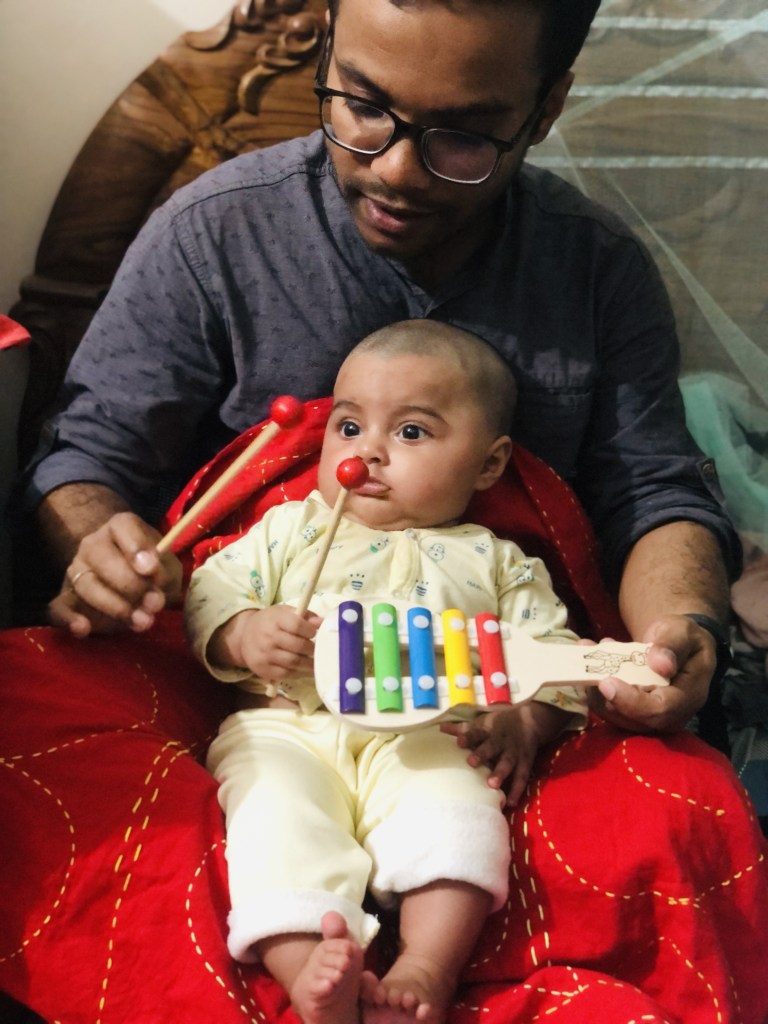
Simple tunes like “Twinkle, Twinkle, Little Star” are easy to play on a toy xylophone and make for a delightful shared musical experience with a baby.
5. 🥘 Age-appropriate food textures (without pressure)
Offer safe, developmentally appropriate textures when your baby is ready:
- not to force speech,
- but to support oral exploration and overall development.
6. 🍽️ Make meals social
Encourage self-feeding when safe and appropriate — not to force speech, but to create natural contexts for communication.
👀 Observe milestones
Respond if your baby:
- Doesn’t babble by ~9 months
- Shows low interest in social sounds
- Doesn’t use gestures like pointing or waving
In those cases, discussing concerns with a pediatrician or speech-language pathologist can be helpful.
🚫 What parents should not worry about
- Your baby does not need special oral exercises to learn to talk.
- Delayed speech is not caused by “not enough chewing.”
- A baby who eats well may still talk late, and a baby who talks early may still struggle with textures.
Speech development follows individual timelines.
🩺 When to seek professional advice
Consider talking to a pediatrician or speech-language pathologist if your baby:
- has persistent feeding or swallowing difficulties,
- shows very limited vocalization or social response,
- loses previously acquired skills,
- Or if you feel something isn’t right.
Early guidance is supportive—not a failure.
📝 The take-home message for parents
Chewing and finger foods support the system, but conversation builds the language. So:
- Talk more than you worry.
- Respond more than you test
- Eat together, talk together, enjoy together.
Your baby is learning to speak not just with their mouth—but with their whole brain, body, and relationship with you ❤️
Support us ❤️
Raising a baby is a journey filled with love, learning, and everyday discoveries. If you find value in what we share on Raising a Baby and would like to support our work, you can contribute via PayPal. Every bit of support helps us continue this journey—thank you for being part of our story.
References
Aswathy, A. K., Arya, S. S., Nourin, V. M., Aparna, T., Thomas, D., & Thuruthummel, B. (2024). Effect of oral placement therapy on feeding skills in children with Down syndrome. Journal of Indian Speech, Language & Hearing Association, 38(2), 185–190. https://doi.org/10.4103/jisha.jisha_57_24
Burr, S., Harding, S., Wren, Y., & Deave, T. (2021). The relationship between feeding and non-nutritive sucking behaviours and speech sound development: A systematic review. Folia Phoniatrica et Logopaedica, 73(2), 75–88. https://doi.org/10.1159/000000000
Chang, S. J., Sim, H. S., & Kwon, M. (2012). Relationship between chewing skills and speech intelligibility in Korean children with spastic cerebral palsy. 音声言語医学, 53(1), 20–26.
Chen, Y., Cabrera, N. J., & Reich, S. M. (2023). Mother–child and father–child “serve and return” interactions at 9 months: Associations with children’s language skills at 18 and 24 months. Infant Behavior and Development, 73, 101894. https://doi.org/10.1016/j.infbeh.2023.101894
Delahunt, A., Callanan, S., O’Brien, E. C., Geraghty, A. A., O’Reilly, S. L., McDonnell, C. M., Hokey, E., & McAuliffe, F. M. (2024). Sensory processing and child appetitive traits: Findings from the ROLO longitudinal birth cohort study. Nutrition Journal, 23(1), 136. https://doi.org/10.1186/s12937-024-00000
Delaney, A. L., & Arvedson, J. C. (2008). Development of swallowing and feeding: Prenatal through first year of life. Developmental Disabilities Research Reviews, 14(2), 105–117. https://doi.org/10.1002/ddrr.16
Farrow, C., Blissett, J., Islam, S., Batchelor, R., Norman, R., Webber, C., Addessi, E., Bellagamba, F., Galloway, A. T., & Shapiro, L. (2025). Approach to complementary feeding and infant language use: An observational study. Maternal & Child Nutrition, 21(1), e13762. https://doi.org/10.1111/mcn.13762
Kuswanti, E., Arifin, I., & Pramono, P. (2024). Oral motor development in children aged 0–12 months: A review of functional and therapeutic aspects. Early Childhood Development Gazette, 1(1), 1–11.
Roxburgh, A., Grasso, F., & Payne, T. R. (2024). Spatio-temporal graph neural networks for infant language acquisition prediction. In Proceedings of the International Conference on Neural Information Processing (pp. 133–148). Springer. https://doi.org/10.1007/00000
Somaraki, M., de Lauzon-Guillain, B., Camier, A., Bernard, J. Y., Tafflet, M., Dufourg, M.-N., Charles, M.-A., Chabanet, C., Tournier, C., & Nicklaus, S. (2024). Timing of food pieces introduction and neurodevelopment: Findings from a nationwide birth cohort. International Journal of Behavioral Nutrition and Physical Activity, 21(1), 118. https://doi.org/10.1186/s12966-024-00000
Webber, C., Blissett, J., Addessi, E., Galloway, A. T., Shapiro, L., & Farrow, C. (2021). An infant-led approach to complementary feeding is positively associated with language development. Maternal & Child Nutrition, 17(4), e13206. https://doi.org/10.1111/mcn.13206


Comments
One response to “How to Foster Your Baby’s Speech Development: What Science Really Says About Feeding, Chewing, and Talking”
[…] How to Foster Your Baby’s Speech Development: What Science Really Says About Feeding, Chewing, and… […]
LikeLike