Have you ever wondered if a toddler — barely two years old — can understand fairness, empathy, generosity, or even say “cheers” before eating a piece of fruit? Last night, I witnessed something that made me stop and rethink what toddlers are capable of.
Keep reading, and by the end, you might want to try a similar “sharing experiment” with your child.
🍊 The Little Tangerine Test: What My Daughter Did
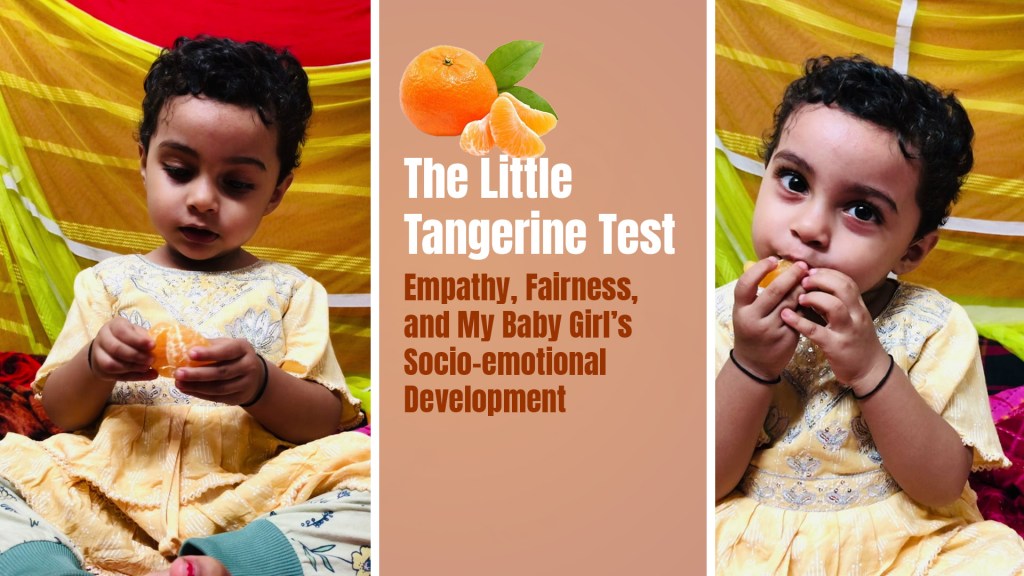
Last evening I gave my daughter exactly 3 pieces (segments) of a tangerine. The whole serving was clearly insufficient for a child her age. Yet, what happened next filled me with pride and deep emotion:
- First, she handed one segment to her mother.
- Then she offered one to me (her father).
- Finally, she kept one segment for herself.
- Before eating, she gently tapped her tangerine against mine — “cheers,” she said — then took a bite and exclaimed with delight: “Wow, it’s tasty!”
Quick Facts
| Date: | 2 Dec 2025 |
| Time: | 10:32 pm |
| Characters: | My Daughter (Age: 2 Years and 1 Month) Me (Her Biological Father) My wife (Her Biological Mother) |
| Location: | Bangladesh |
There was no urging. No reminding. No negotiation. Only a spontaneous act of sharing, fairness, and gratitude. In that simple moment, she demonstrated more than manners: she exhibited empathy, fairness, generosity, and appreciation. For us, as parents, it felt like witnessing the emergence of emotional intelligence — compassion and kindness in her tiny, generous heart.
Watch the video
This little tangerine-sharing ceremony wasn’t just adorable. From what I know now about child development, it was scientific evidence in motion: a real illustration of how early social-emotional traits — sharing, fairness, empathy — can and do emerge in young children under supportive, loving conditions.
Why Sharing Matters — According to Research
Sharing is not a trivial behavior. It plays a crucial role in children’s long-term socio-emotional development. Research has shown that even very young children begin to show sharing-related behaviors, and these early tendencies can predict future social skills, empathy, and moral reasoning (Malti et al., 2012; Söldner & Paulus, 2025).
- According to a longitudinal study of 175 children aged 6, increases in sharing of valuable resources between ages 6 and 9 were strongly linked to their early capacity for sympathy toward anonymous others. Early social acceptance and social-emotional skills predicted later sharing behavior — even after controlling for IQ and socioeconomic status (Malti et al., 2012; Ongley & Malti, 2014).
- Another study focusing on 4–6-year-old children found that theory of mind (ToM) — the child’s ability to understand others’ mental states — along with anticipated and consequential emotions, significantly influenced sharing and resource-allocation behavior. Children with more advanced ToM and emotional awareness tended to share more fairly and generously (Shi et al., 2024).
- For even younger children, including infants, sharing behavior can be encouraged: an experiment showed that 7-month-old infants increased their willingness to share after their parents encouraged reciprocal exchanges (rather than simply giving objects) (Xu et al., 2016).
- Further, in children aged 3–5 years, secure attachment with caregivers was associated with more frequent helping, sharing, and comforting behavior — key components of early prosocial disposition (Beier et al., 2019; Brownell et al., 2013).
- Recent neurodevelopmental research also suggests that in resource-inequality scenarios, children’s positive emotional state and inhibitory control (i.e., self-control) are associated with greater sharing. That is, children are more likely to behave generously when they feel good and are capable of controlling immediate self-interest (Peng et al., 2025).
In short: sharing and caring are not just learned “good manners.” They are deeply rooted in children’s cognitive and emotional development. Early childhood is a sensitive period where these prosocial behaviors — fairness, empathy, generosity — begin to take shape, especially when nurtured by a supportive environment (Brownell et al., 2013).
How Our Story Reflects Scientific Principles
Looking back at that simple tangerine evening, I realize how many of these scientific findings played out in real life:
- Empathy & Prosocial Orientation: By sharing immediately without prompting, our daughter showed that she was capable of other-oriented behavior — not just self-interest. Her act echoes findings that sympathy and early social-emotional awareness strongly predict sharing behavior later.
- Fairness & Resource Allocation: Despite only three slices, she distributed them equally — one per person — rather than hoarding or negotiating. That aligns with evidence linking fairness and resource-allocation behavior to social-cognitive development (like ToM) in preschoolers.
- Emotional Gratitude & Positive Affect: Her “wow, it’s tasty” reaction reveals appreciation and positive emotion. Recent studies suggest that positive emotional states and self-control together can support altruistic sharing even in unequal or constrained resource situations.
- Natural, Unforced Behavior in a Supportive Environment: We did not pressure her or frame a “challenge.” Instead, we created a safe, trusting environment — something research highlights as essential for social-emotional development (Jeannie Ho, 2018).
This is why, for us, that simple moment wasn’t just a snack — it was an early milestone in emotional intelligence.
What This Means for Parents & Caregivers — Practical Lessons
From our experience and the research, here are some takeaways for parents or caregivers who wish to nurture emotional intelligence in their children:
- Create everyday opportunities for sharing — even in small, ordinary moments. Something as simple as sharing fruit, snacks, toys, or even time can help children internalize generosity and fairness.
- Model empathy, fairness, and gratitude yourself. Children learn a lot by observing. By treating others with care, you set an example.
- Encourage conversations about feelings, fairness, and caring. According to studies, discussions about emotions and perspective-taking can nurture prosocial behavior (Brazzelli et al., 2021).
- Recognize and praise spontaneous sharing or kindness. Positive reinforcement helps. Acknowledge when children do good on their own — it reinforces their internal motivation rather than forcing behavior.
- Be patient and supportive. Prosocial behaviors can emerge early but continue to develop over time, influenced by cognitive, emotional, and social factors. Supporting them through consistent care and nurturing helps build a strong foundation.
Concluding Thoughts: More Than a Tangerine
That evening with the three tangerines — which at first seemed mundane — turned into an unforgettable lesson. It reminded me how powerful love, empathy, and fairness are. It showed how early, tiny acts can reflect deep psychological and moral development, and how as parents we play a key role in shaping that inner world.
If we continue to nurture these moments — with kindness, patience, and awareness — perhaps one day she will look back and carry in her heart not just the memory of a shared fruit, but the values of generosity, empathy, and gratitude.
As parents, we often expect trophies and grades; but sometimes the most profound milestones are silent, subtle — like a “cheers” between little tangerines.
References
Beier, J. S., Gross, J. T., Brett, B. E., Stern, J. A., Martin, D. R., & Cassidy, J. (2019). Helping, Sharing, and Comforting in Young Children: Links to Individual Differences in Attachment. Child Development, 90(2), e273–e289. https://doi.org/10.1111/cdev.13100
Brazzelli, E., Grazzani, I., & Pepe, A. (2021). Promoting prosocial behavior in toddlerhood: A conversation-based intervention at nursery. Journal of Experimental Child Psychology, 204, 105056. https://doi.org/https://doi.org/10.1016/j.jecp.2020.105056
Brownell, C. A., Iesue, S. S., Nichols, S. R., & Svetlova, M. (2013). Mine or Yours? Development of Sharing in Toddlers in Relation to Ownership Understanding. Child Development, 84(3), 906–920. https://doi.org/10.1111/cdev.12009
Jeannie Ho, S. F. (2018). Promoting Young Children’s Social and Emotional Health.
Malti, T., Gummerum, M., Keller, M., Chaparro, M. P., & Buchmann, M. (2012). Early sympathy and social acceptance predict the development of sharing in children. PloS One, 7(12), e52017. https://doi.org/10.1371/journal.pone.0052017
Ongley, S. F., & Malti, T. (2014). The role of moral emotions in the development of children’s sharing behavior. Developmental Psychology, 50(4), 1148–1159. https://doi.org/10.1037/a0035191
Peng, Q., Zhang, J., Liu, G., & Li, H. (2025). Positive emotions and inhibitory control enhance prosocial sharing behavior in children under unequal resource conditions: An fNIRS study. NeuroImage, 319, 121434. https://doi.org/https://doi.org/10.1016/j.neuroimage.2025.121434
Shi, Y., Zhang, M., & Zhu, L. (2024). Sharing and Allocation in Preschool Children: The Roles of Theory of Mind, Anticipated Emotions, and Consequential Emotions. Behavioral Sciences, 14(10), 931.
Söldner, L., & Paulus, M. (2025). The moral self in formation: Caregiver emotional availability and early prosocial behavior predict preschoolers’ moral self-concept. Developmental Psychology, No Pagination Specified-No Pagination Specified. https://doi.org/10.1037/dev0001902
Xu, J., Saether, L., & Sommerville, J. A. (2016). Experience facilitates the emergence of sharing behavior among 7.5-month-old infants. Dev Psychol, 52(11), 1732–1743. https://doi.org/10.1037/dev0000174


Comments
2 responses to “Empathy, Fairness, and My Baby Girl’s Socio-emotional Development: Our Tangerine Experience”
@raisinga.baby I once read about empathy development process in some parenting book, with steps like imagining other's side perspective or emotional resonance explained and illustrated, and later I saw my child doing stuff that made me wonder if those observations from the book were accurate (even though there were based on some psychological experiments) or the researchers didn't appreciate toddlers enough. And the more ny child grows the more I am convinced that children are more emotionally and socially developed than most people would think, you just have to know where and when to look to see it.
LikeLiked by 1 person
Thank you so much for sharing this! I completely relate. It’s incredible how often our little ones surprise us by showing a level of empathy and social awareness far beyond what the books predict. Research gives us helpful frameworks, but it’s those real-life moments — the perspective-taking, the tiny acts of kindness, the emotional attunement — that truly bring everything to life.
In fact, my daughter started showing clear signs of empathy and kindness around 18 months. We used to have breakfast together, and one day she reached over and offered me food, gently feeding me with her little hand — just the way we feed her. I wish I still had the video of that moment, because I try to document these experiences as accurately as possible in case they might one day be useful as meaningful observations for 𝗿𝗲𝘀𝗲𝗮𝗿𝗰𝗵𝗲𝗿𝘀.
I really love how you put it: “𝙮𝙤𝙪 𝙟𝙪𝙨𝙩 𝙝𝙖𝙫𝙚 𝙩𝙤 𝙠𝙣𝙤𝙬 𝙬𝙝𝙚𝙧𝙚 𝙖𝙣𝙙 𝙬𝙝𝙚𝙣 𝙩𝙤 𝙡𝙤𝙤𝙠.” It’s so true. These glimpses into their inner world feel like such precious gifts and remind me how capable, aware, and emotionally complex very young children can be. Your comment resonated deeply with me.
If you don’t mind, could you share the name of the book you mentioned?
Thanks again for taking the time to write — I truly appreciate it.
Regards
Sajal Kanti Ghosh
Father of Durga (the baby girl)
LikeLike