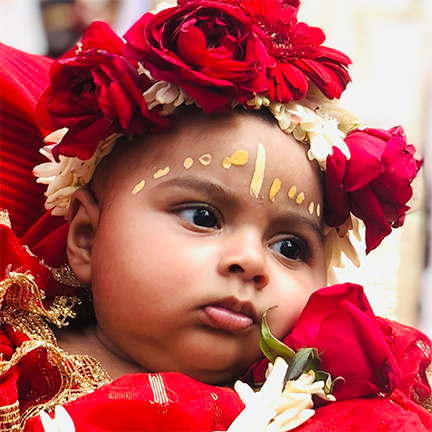

Treasure hunt games can be a delightful 🤩 and educational 🎓 way to engage toddlers🔗. By combining elements of exploration 🧭, physical activity ⛹️♀️, and problem-solving 💡, these games can promote curiosity, situational awareness, gross and fine motor skills🔗, observational capacity, and physical flexibility. Here, I share my personal experience playing a treasure hunt game with my 14-month-old daughter, backed by scientific insights, so you can replicate this activity with your child.
🎯 Objectives
The game was designed to:
- Encourage her to walk independently,
- Assess her attention to detail 🔎 (spotting small objects),
- Test her ability to recognize the bigger picture 🌆,
- Test her decision making skills,
- Enhance both her gross and fine motor skills.
What Does Science 🧬 Say?
Serious fun: Preschoolers engage in more exploratory play when evidence is confounded
A research by Schulz and Bonawitz (2007) explored how young children learn through play, especially when they encounter situations that are not straightforward.
Key Idea:
The study found that preschoolers are more likely to engage in exploratory play when the situation or evidence is unclear or “confounded.” In simpler terms, when kids see something happen and aren’t sure why it happened, they become more curious and spend more time experimenting to figure it out.
What They Did:
The researchers presented preschoolers with toys that could do different things (like make noise or light up). In some cases, it was clear what caused the toy’s actions. In other cases, the cause was unclear—there was some mystery about how the toy worked.
What They Found:
When the cause of the toy’s actions was unclear, the children played with the toy for longer and in more creative ways. This suggests that ambiguity or mystery sparks curiosity and encourages kids to explore more deeply.
Why It Matters:
This study shows that young children are natural scientists. When they encounter something puzzling, they instinctively experiment to figure it out. This kind of play is critical for learning and cognitive development because it helps kids develop problem-solving skills and learn about cause-and-effect relationships.
Practical Implication:
If you want to encourage children’s learning and curiosity, give them toys or activities that are slightly challenging or ambiguous. Let them figure things out for themselves rather than providing all the answers right away.
Source: Schulz, L. E., & Bonawitz, E. B. (2007). Serious fun: Preschoolers engage in more exploratory play when evidence is confounded. Developmental Psychology, 43(4), 1045-1050. https://doi.org/10.1037/0012-1649.43.4.1045
Day 1: Exploring the Unfamiliar
On the first day, we introduced 12 small spinner toys (1.5 inches wide, available in two color variants: blue and green) to her playground. These toys were entirely new to her, as she had never seen such objects before. They were strategically scattered in plain sight to spark her curiosity and assess her attention to details.
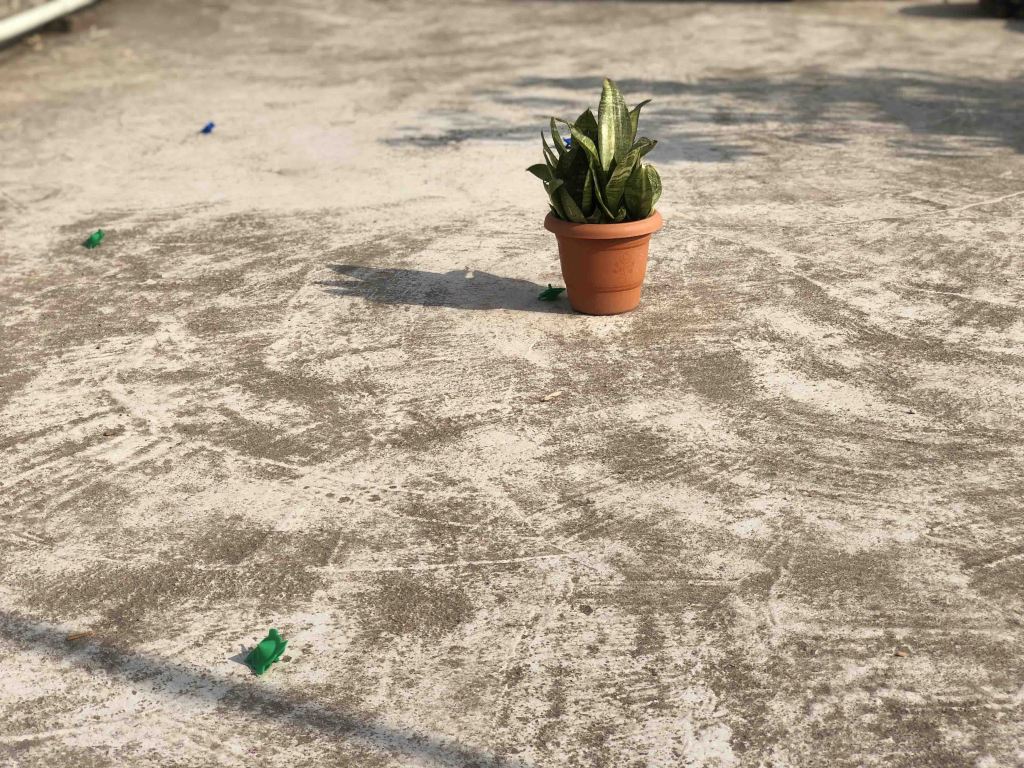
We anticipated she would notice 👀 the objects, pick ✊ them up, and place them in a 🪣 bucket. Since she is still learning to walk 🚶♀️independently, the game required her to transition smoothly between walking, stopping, and sitting to collect the items.
Outcomes: Day 1
Introducing unfamiliar objects fosters curiosity and problem-solving. According to research by Schulz and Bonawitz (2007), children are naturally motivated to explore and learn from their environment when presented with novel stimuli.
She displayed an impressive ability to notice and collect all the (12) objects. While her observational skills, attention to details and coordination were evident, a minor accident occurred as she rushed to pick up the last object. She lost balance and sustained a small palm injury. This highlighted the importance of close supervision and creating a safe environment for such activities.
Day 2: A Week Later, Familiar Meets the New
A week later, we repeated the game with some variations. This time, we introduced familiar, larger objects like a coffee cup 🥤, a medication bottle 🍶, and two plastic balls 🎾 alongside the smaller objects (spinner toys) from the first day.
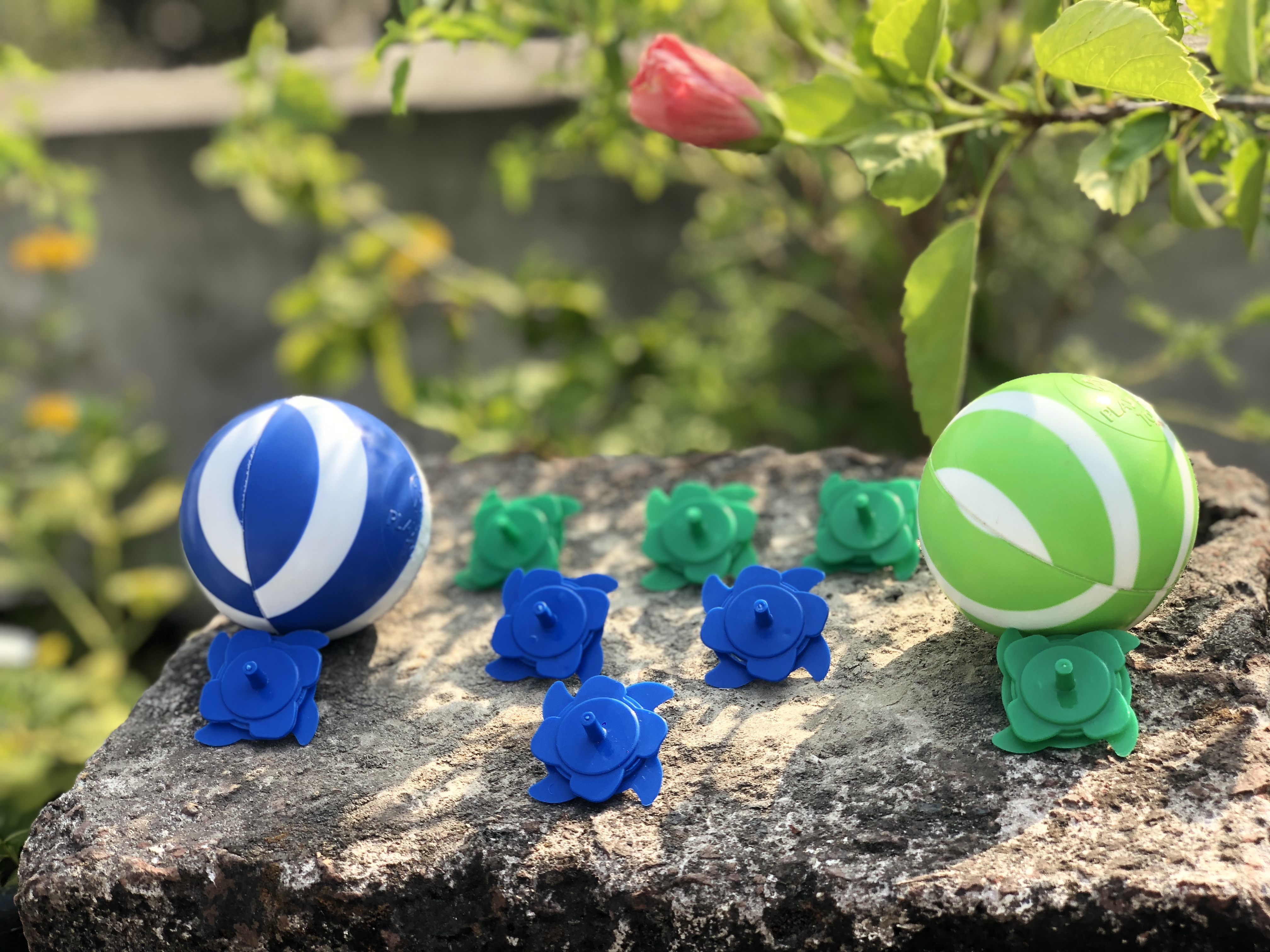
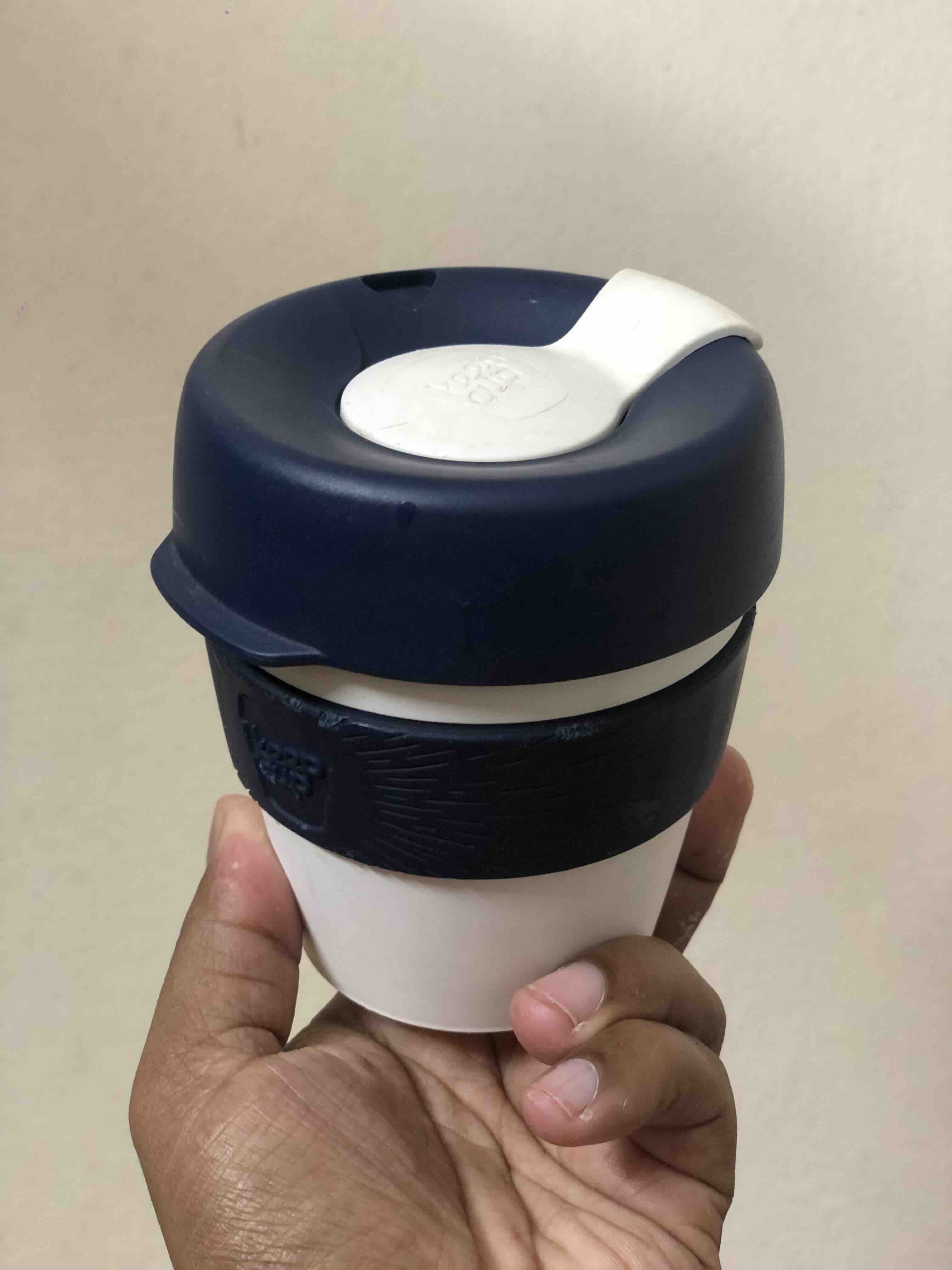
Day 2: Objects used on the second day. © Sajal & Associates
Outcomes: Day 2
Interestingly, this time, she prioritized the larger, familiar objects and initially ignored the smaller ones. Over time, she collected some smaller objects but surprised us by also picking up unwanted objects like leaves 🍂 and small sticks. This change in behavior reflects her growing awareness and ability to make choices based on familiarity and curiosity. The inclusion of both familiar and unfamiliar elements likely stimulated different cognitive and observational pathways.
Combining familiar and unfamiliar elements challenges a child’s working memory and ability to observe and differentiate. This process strengthens cognitive processing and memory recall (Diamond, 2013).
Situational Awareness, Self Awareness and Precision
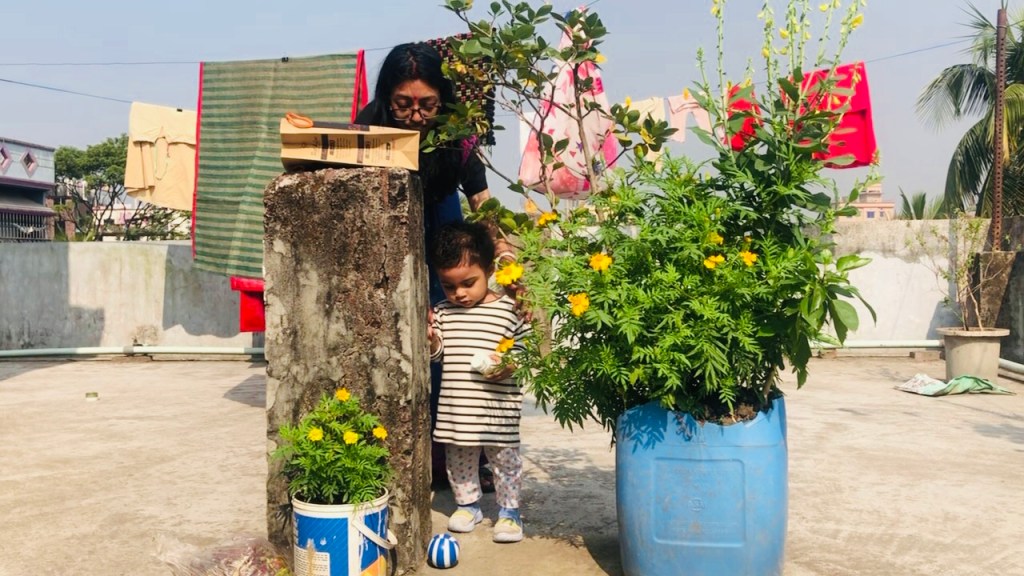
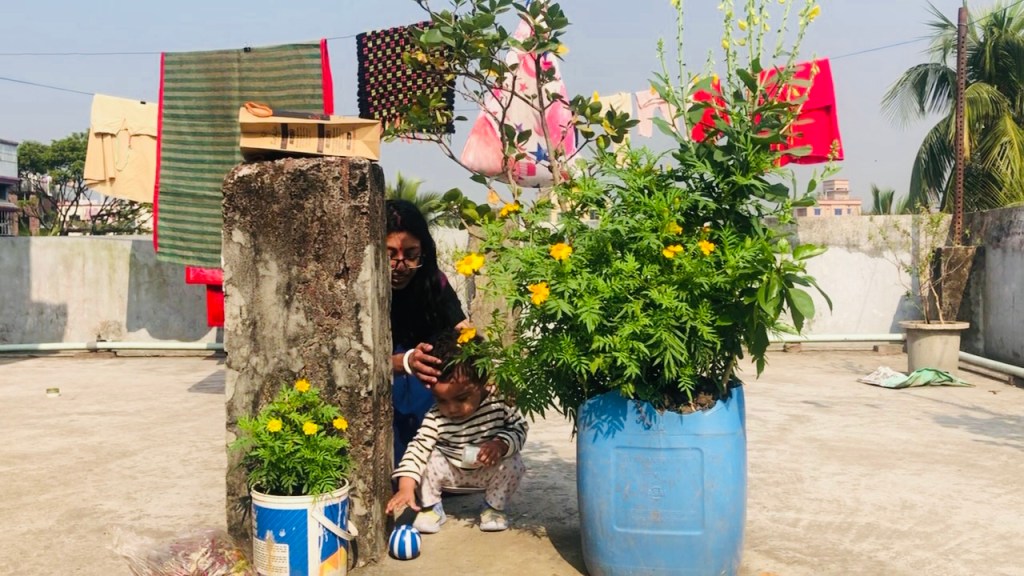
Picking the ball from this narrow space without damaging the flowers 🌼 or the plant 🌱 —and most importantly, ensuring her own safety 🛟 by avoiding injury from the pillar—posed a reasonable challenge. This scenario highlights her situational awareness, ability to assess her own capabilities, problem-solving skills, and her capacity to balance gross motor skills with fine motor precision. Needless to say, her mom was always supervising to ensure her safety.
Decision-Making Dilemma (Opportunity Cost & Trade Off)
At one point in the game, she faced a decision-making dilemma. Both her hands were occupied—one holding a ball and the other a medication bottle. As she noticed the largest object in the game, a coffee 🥤cup, on the ground, she decided to pick it up.
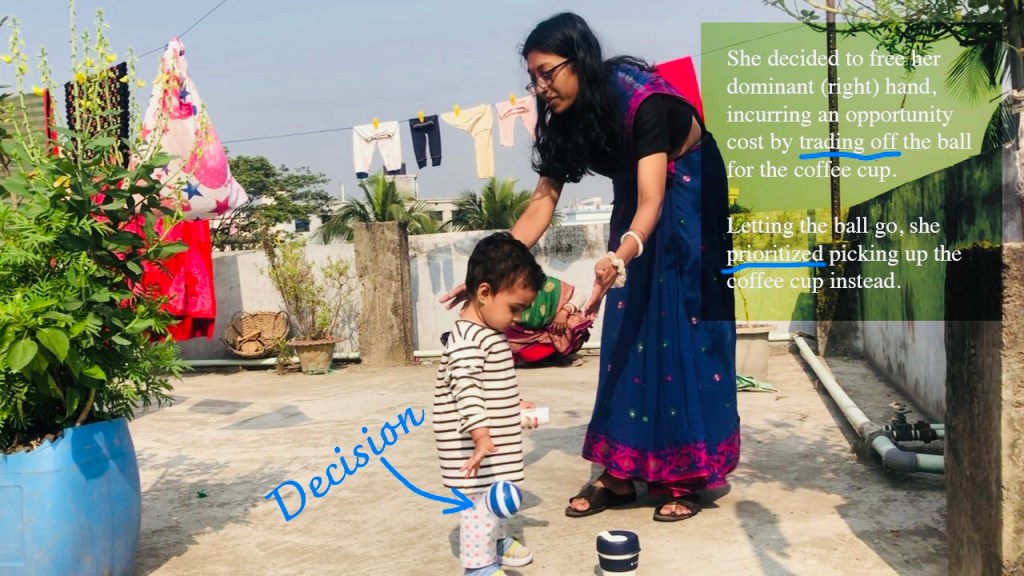
However, since both of her hands were already full, she had to make a trade-off: let go of one object to free a hand for the coffee cup.
After a few moments of thought, she made her decision. She dropped the blue ball 🔵, freeing her dominant right hand to pick up the coffee 🥤cup.
Two important observations can be made here:
- She is right-handed, which means her right hand is her dominant hand for grasping and manipulating objects.
- The coffee cup was quite large, making it difficult for her to hold it securely with just one hand.
Given these factors, her decision to free her right hand was a smart and practical choice.
Note: In economics, the term trade-off is often expressed as opportunity cost. A trade-off involves a sacrifice that must be made to obtain a desired product or experience. Understanding the trade-off for every decision you make helps ensure that you are using your resources (whether it’s time, money or energy) wisely.
Gross and Fine Motor Skills
Gross motor skills / control is the ability to make large, general movements (such as waving an arm or lifting a leg). It requires proper coordination and function of muscle, bones, and nerves (National Library of Medicine (U.S.), 2023). Walking, bending, and sitting enhance gross motor skills, critical for balance and coordination. Activities involving varied movements improve muscle strength and postural control in toddlers.
Children develop fine motor skills over time, by practicing and being taught. To have fine motor control, children need (National Library of Medicine (U.S.), 2023):
- Awareness and planning
- Coordination
- Muscle strength
- Normal sensation
Picking up small objects helps refine grip and hand-eye coordination. Research highlights that grasping activities are essential for the development of precision and dexterity (Cleveland Clinic, 2023).
Tips for Parents:
- Ensure Safety: Choose a soft, non-slip surface for the activity. Supervise closely to prevent accidents.
- Use Age-Appropriate Objects: Start with larger objects and gradually introduce smaller ones as your child’s dexterity improves.
- Introduce Variety: Mix familiar and unfamiliar items to keep the game engaging and stimulate curiosity.
- Encourage, Don’t Pressure: Celebrate 🎉 small successes to build confidence and intrinsic motivation.
- Adapt the Game: As your child grows, you can hide objects or add challenges like color sorting or counting.
Conclusion
The treasure hunt game is more than just a playful activity; it’s a pathway to learning and development. By encouraging toddlers to explore, observe, and move, this game supports multiple developmental milestones. With careful planning and supervision, parents can create a safe and enriching environment for their children to thrive.
Why not try a treasure hunt game with your toddler today? Share your experiences and observations — let’s inspire each other to nurture our children’s growth and curiosity.
References
- Cleveland Clinic. (2023, September 8). Fine motor skills. Cleveland Clinic. https://my.clevelandclinic.org/health/articles/25235-fine-motor-skills
- Diamond, A. (2013). Executive functions. Annual Review of Psychology, 64(1), 135-168.
- National Library of Medicine (U.S.). (2023, April 27). Gross motor control: MedlinePlus Medical Encyclopedia. https://medlineplus.gov/ency/article/002368.htm
- National Library of Medicine (U.S.). (2023, January 24). Fine motor control: MedlinePlus Medical Encyclopedia. https://medlineplus.gov/ency/article/002364.htm
- Schulz, L. E., & Bonawitz, E. B. (2007). Serious fun: Preschoolers engage in more exploratory play when evidence is confounded. Developmental Psychology, 43(4), 1045.


Leave a comment